“Goes in like honey.”
This phrase describes the product’s observed appearance during pouring. It is a visual comparison, not a measured viscosity or flow-rate claim.
The behavior of the blend
We have been asked: "What makes S2N different? It sounds just like A way to describe what we observe when S2N-35 and motor oil work together—and why the finished blend deserves its own evaluation.
Appearance starts the conversation. Testing helps us ask better questions about performance.
Explore the observations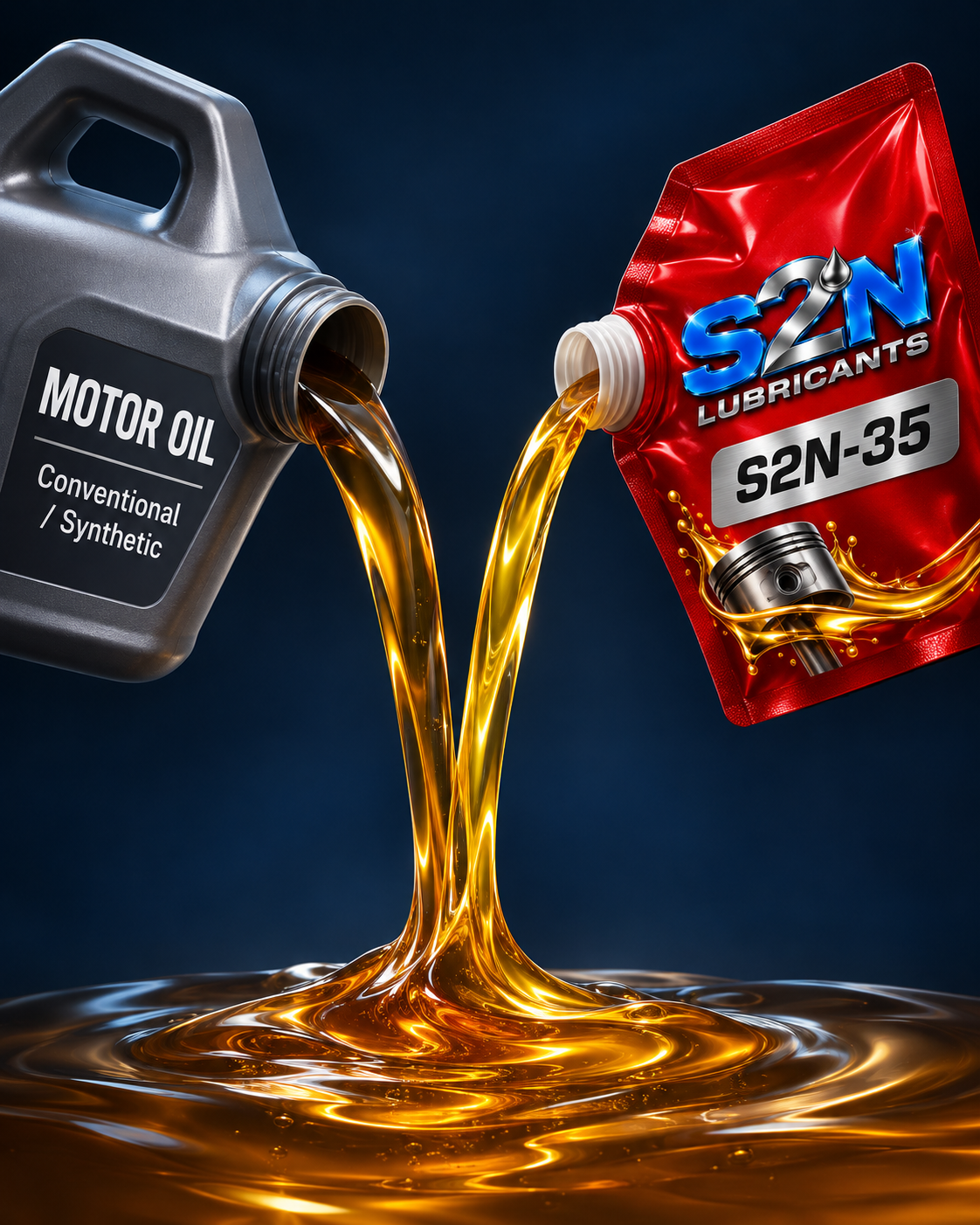
What emergence means here
“Emergence” is our descriptive name for the behavior observed in the combined lubricant. It invites a practical question: how does the finished blend behave under the conditions being tested?
The term does not establish a chemical transition or prove how a blend will perform inside an engine. Those questions require measurements, defined test conditions, and application-specific evidence.
Appearance observations
This phrase describes the product’s observed appearance during pouring. It is a visual comparison, not a measured viscosity or flow-rate claim.
The reported drained-oil observation was that it looked like normal used oil. Appearance alone does not establish viscosity, lubricant condition, or the mechanism behind a result.
These observations are not draining or maintenance instructions. Follow the applicable product directions and equipment maintenance requirements.
Extended-duration in-house bench testing
Across all of our extended-duration in-house bench testing, we observed stable behavior without seizure. These observations relate to S2N-35 MAX test blends and should not be presented as results for the standard retail blend.
We stopped testing at 180 minutes because the observed behavior had stabilized. Within the first hour, we observed no further change. By the time we stopped, the temperature had remained stable for two hours.
The drag had fallen so much that, to the operator, the machine appeared to be carrying almost no drag. This describes the operator’s impression of drag; it is not a measurement of zero load or zero friction.
Continue with the evidence
Explore the testing material available from S2N. Consider the test method and conditions alongside each result, and distinguish bench observations from evidence collected in an operating engine.
Testing & Evidence